Pages

Showing posts with label Environment. Show all posts

Tuesday, January 13, 2009

The hippies are at it again. This time with "sea kittens".


How's that for timing? PETA is trying to "save the fish" by rebranding them from "slithery and slimy, and they have eyes on either side of their pointy little heads" (their words, not mine) to "sea kittens."

Again, I am not making this up.

It would appear people don't care about scaly, slimy fish and are all too eager to have someone hook, club, slice, gut, cook, and squeeze lemon over one for consumption. They needed to come up with a way to change people's perception of fish. I can see the brainstorm session now:
"So how do we create an emotional attachment to fish? They're ugly and eat worms."

There is a long pause with lots of "hmmmming" and pencils being tapped on empty pads of paper. (I know what this is like because I do it for a living.) Eventually someone tentatively says, "People like cats."

There's another pause while everyone thinks about this. "But cats eat fish too," someone in the corner calls out.

At this point, they should have killed the idea and moved on to something else. Sadly, this did not happen.

"True," a creative director offers, "But instead of cats eating fish, what if the cat was the fish! We change the entire way people view fish! Instead of viewing them as slimy underwater worm-eaters, we get people to see them as cats! Little, adorable kittens. Ah-HA!" His hands are stretched like he can see the headline floating in front of him. "Sea kittens!"

A flurry of note taking begins where everyone who works under this creative director tries to capture their understanding of his vision. Hasty sketches are drawn. Headline options are furiously scribbled. No one has the guts to say, "This is stupid."
So that's their first problem: they assume everyone likes cats. This is false. Not all people like cats. People like me. In fact, this campaign makes me want to eat more fish simply because they are now being associated with an animal I strongly dislike.

The site urges visitors to fill out a petition to to the US Fish and Wildlife Service to "save the sea kittens." I presume the people who work at the US Fish and Wildlife Service are well-educated people, particularly about animals and species and  the like, and are aware that there is no such thing as a sea kitten. This would make it very difficult for them to be saved since, you know, they don't exist. That's PETA's second problem.

However, PETA has been kind enough to provide the functionality to Create Your Own Sea Kitten. You know, to give you something visual to picture the next time you're looking at a piece of salmon on your dinner plate. This is mine:


I named him/her/it "Lunch". Why? Because of PETA's third problem: they neglected to put a "sound off" button on their site which drives me nuts. So I'm going to have a fillet o' fish today for lunch. From a fast food pace. In a food court. In a strip mall.

Saturday, December 13, 2008

Wednesday, June 18, 2008

Wednesday, March 12, 2008

$5 bounty on stray cats? Sign me up!

So this city in Iowa is having problems keeping their stray cat population under control. The city council decided to pay alert, proactive, responsible citizens (you know, people who don't have cats) five bucks for each stray cat they bring in.

Unfortunately, it appears that you have to bring the cats into the vet alive so the vet can do what? Kill them. Seems like you could follow Jim's example (see above photo) and save some money - a .22 round is cheaper than a shot at the vet.

Dang it. I thought I could retire early. Rob, our dream will have to wait.

Photo from here. See the original CNN video here.

Saturday, January 26, 2008

Ethanol may be back in the running as an alternative energy source

I'll quote some highlights from the article, then the link if you're interested in learning a bit more. But first, some background.

Ethanol (or E85 which is 85% ethanol and 15% gasoline) was once looked upon as a possible replacement for oil - we can make it here in the U.S. reducing our dependence on foreign oil, it's renewable (most likely from corn) and it's burns cleaner than gasoline. Sounds swell.

However, it has a couple of negatives as well. It's been driving up the price of corn (which makes other things more expensive as well), it takes just about as much energy to make ethanol as using gasoline in a car so there aren't any real environmental benefits after all and there's the whole ethical thing of using corn to drive our cars while people in our country and around the world are starving.

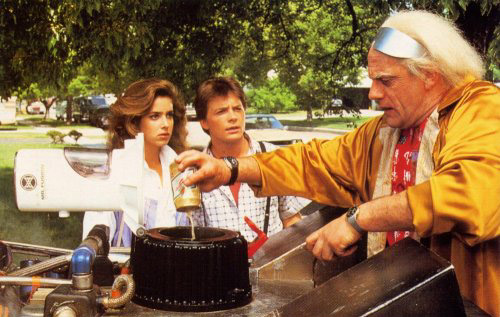
Fortunately, a company called Coskata has come up with a way to create ethanol that's seven times more efficient than gasoline, only costs $1 gallon to make and you can use any kind of biomass material - a lot of the stuff you put down the garbage disposal or throw away in the trash. Remember Mr. Fusion from Back to the Future II? Kinda like that. But non-nuclear.

OK. Now on to the quotes:

• It's not five years away, it's not 10 years away. It's affordable, and it's now.

• Coskata's ethanol produces 84 percent less greenhouse gas than fossil fuel even after accounting for the energy needed to produce and transport the feedstock. It also generates 7.7 times more energy than is required to produce it. Corn ethanol typically generates 1.3 times more energy than is used producing it.

• If you're in Orange County, you can use municipal waste. If you're in the Pacific Northwest, you can use wood waste. Florida has sugar. The Midwest has corn. Each region has been blessed with the ability to grow its own biomass.

Sounds good, eh? Read the rest of the details here. Then buy some Coskata stock.

Corn image courtesy of here. Mr. Fusion image from here.

Friday, October 12, 2007

Al Gore wins Nobel Peace Prize (seriously) - UPDATED

See here.

While I definitely think things need to be done about the way we treat the environment, and I've blogged about An Inconvenient Truth before, it seems a little weird that Al Gore's work on climate change wins a Nobel Peace Prize.

I don't get it.

UPDATE: Apparently I'm not the only one with this thought. NPR had a bit on it here.

(Photo courtesy of USA Today)

Wednesday, August 08, 2007

Announcing a new blog

It seems life continues to become increasingly complicated. Our attention is being vied for from more and more sources and it can become overwhelming.

About a month ago I started a new blog called LivSimpl. The goal is to provide daily tips on how to simplify life, eliminate distractions and enjoy the simple things that we might overlook in the rush of the daily grind.

I've already built up about 25 tips, so please take a second or two to check it out and subscribe via RSS. Or, if you prefer, you can subscribe to a daily e-mail tip.

Eventually I'd like to get to the point where I have enough readership to have contests, giveaways, etc. So if you know anyone who might be interested, please let them know about LivSimpl.com!

Wednesday, July 11, 2007

Stop driving so @#$% much!


One person can make a difference. Cut down on driving! Walk, take public transportation, carpool, combine trips. Your dependence on foreign oil is nobody's fault but your own. (Obviously, the same goes for me.) And as the graph at the bottom illustrates, gas prices can still go way, way up.

We'll either have to start driving less by force or by choice. Make it the latter. Personally, I find a lot of satisfaction in taking TRAX to work, carpooling and walking when I can. Matt and Andrea ride their bikes to work. I'm certainly not perfect at this (especially this week with a sick newborn). But if you haven't tried any of those alternate methods of transportation I highly encourage you to do so.

via The Economist

Tuesday, July 03, 2007

Green misconceptions

Just to be clear, you don't have to dress (or act) like this


nor live like this


to be environmentally savvy/green.

You don't have to be nut job. Just make a conscious effort to continually do a little better: turn off lights when you leave a room. Walk to that friend's house instead of drive. Recycle your office paper and pop cans instead of throwing them away.

A few small steps in the right direction can make a lot of difference. So don't be afraid to take upon you the title of "green".

Remember Bob, and just take baby steps.

Friday, June 29, 2007

Bald eagles back from the brink

With only 417 nesting pair left in the 1940's, the bald eagle has been removed from the endangered species list and is thriving with about 10,000 pair living throughout the U.S.

This is a great example of what can be done for the environment if people will stand behind a cause.


Thanks to USA Today for the pic.

Sunday, June 24, 2007

Better than lead to gold

Unlike this guy, Purdue scientists have found a way to turn water into hydrogen without an external power source.

And like so many brilliant advances, it happened by accident.

"I was cleaning a crucible containing liquid alloys of gallium and aluminum," said Purdue University professor Jerry Woodall. "When I added water to this alloy--talk about a discovery--there was a violent poof. I went to my office and worked out the reaction in a couple of hours to figure out what had happened."

CNET explains some of the hurdles that have stood in the way of hydrogen going mainstream:

Many of the major automakers, including Honda, and General Motors, have invested heavily in developing fuel cell-powered cars. However, to date hydrogen has faced significant obstacles to becoming a viable alternative to gasoline, principally the expensive (and often carbon-fueled) process of isolating it, and the lack of a fueling infrastructure. The Purdue development has the potential to address both of these issues.

Sure enough, the quest for hydrogen that can be produced in vehicles is a bit like a dream of modern alchemy. It looks like the scientists at Purdue have had the eureka! moment they were looking for.

Of course, if this does go mainstream, the price of oil will drop significantly. Still, a pollution-free way to power our vehicles without building new infrastructure and completely severing our reliance on foreign oil? Jackpot. If I owned the patents, I'd license it out while retaining ownership. Dang. Talk about big bucks. BILLIONS.

Instead, maybe I'll invest in aluminum.

Saturday, June 23, 2007

Who Killed the Electric Car?

Who Killed the Electric Car? is an interesting documentary about the rise and fall of the electric car in the 1990's.

California passed a zero emissions mandate in 1990 requiring automakers to make a certain percentage of their fleets zero emissions by a certain date, due mainly to the horrid and very unhealthy air quality conditions in California.

The General Motors' EV1 was an electric car that met those standards.

Getting around 100 miles per charge, it was more than adequate for most people's daily driving needs. "Filling up" the car was done by plugging it in either at home or at a charging station around town.

It cost about a third as much to charge it as it would have to buy a comparable amount of gas and it took about 50 EV1s to create as much pollution as one gasoline powered car.

Then came the opposition. California's zero emission mandate was repealed after heavy lobbying from automakers, the petroleum industry and the White House. GM took back all the EV1s when their leases expired, despite the begging and pleading from their owners to extend their lease or to even buy the car.

A short while later, 78 EV1s were discovered in a fenced-in parking lot behind a GM office building. EV1 drivers got together, collected money and offered GM a check for $1.9 million to take the cars they were planning on scrapping anyway. GM refused.

There's a lot more to the documentary, including what GM did and didn't do to promote the cars, what people had to do to actually lease them (one guy had to wait six weeks despite the fact that the car he wanted was just sitting there on the lot) as well as exploring who the culprits were behind the death of the electric car.

One of the more interesting culprits, they say, is hydrogen. Despite the success and demand for the EV1, automakers, The White House and the oil industry lobbied against it in favor of hydrogen powered vehicles. While that may not sound so terrible, the theory of using hydrogen to power cars is a little like saying you're going to turn lead into gold. It takes a lot of money and energy to create hydrogen and if it were to ever become wide-spread it would require an entirely new distribution infrastructure. And that's exactly why automakers, the oil industry and good ol' boy George W. (aren't those synonymous?) are promoting it: appear to be trying to do something good when you think it will never take off.

Most of the hour and a half-long movie is interesting and thought-provoking, although there are a couple scenes where environmental activists do things that make me think, "That's why people don't take you seriously." Like having a funeral service for a car. Other than that, it's definitely worth the cost of the rental.

Saturday, April 28, 2007

Nature

As I was walking downtown the other day I became acutely aware of the hardness of the cement as the slap of the soles of my shoes jarred my body. This artificial pathway to work lead me to think of the plastic chair I would be sitting in at my desk. My desk is... made of what? I have no idea. Some bizarre plastic composite perhaps?

I would spend my day indoors where natural light is abundant but the air is recycled. Phones and intercoms and the chime of computers notifying their users of new messages and appointments were destined to fill my ears for the next eight to ten hours.

Eight to ten hours. Half of my waking life.

I paused at a crosswalk, a red hand halting my progress as dozens of cars rumbled by making the air difficult to breathe.

Slap, slap, slap. The red hand gave way and I continued on, each step a subtle concussion through my body. So subtle, in fact, they had previously gone unnoticed. How? I walked the same route from the train to the office every day. Yet this particular day I felt strangely disconnected. Or perhaps I was more connected. Sometimes it's hard to tell the difference.

Token planting pots, often neglected, lined my path. Partially filled with soil, the remainder filled with trash or cigarette butts, the withered inhabitants tried to rise.

Rise.

Slap, slap, slap. My shoes called my attention downward, unwilling to let me forget their constant battle with the cement.

The cement was before me and behind me. It ran to my left into the road and to my right up the buildings. This was the layout that would guide me to the half of my life spent breathing forced air and sitting in a synthetic chair before a desk and glowing screen.

Then my hand did something most peculiar. As if to give my shoes hope, it rose into a tree and ran its fingers through the thick, green leaves on its low-hanging branches. A calm ran through my body clear down to my feet, which instantly slowed to savor the sensation. The cool, pliable leaves grazed over my hand and slid through my fingers. For the first time in a long time, I'd touched something living and organic, energizing my body and bringing life to my soul.

Monday, April 23, 2007

Funnel cloud in Salt Lake


Snapped this shot on my way home from work. If you look at the left side of the picture just above the cement barrier you can clearly see a funnel cloud forming. I took these pictures on 500 South coming out of downtown.

Click the pics for a much bigger images.

Monday, January 22, 2007

Getting zero miles per gallon

If your car is idling, you're getting zero miles per gallon. Sucks, huh? I quote from Treehugger:

While older cars from the 1970s and early 1980s might have needed time to warm up, the norm since the mid-1980s has been fuel-injection vehicles which can be restarted frequently without engine damage. When you start a car’s engine, a little bit of extra gas is used to get the combustion process started. That means a good rule of thumb for conserving gas is to idle for no more than 30 seconds, except, of course, if you’re just sitting in traffic. If you have a hybrid car, it does the work of avoiding idling for you. While parked or sitting in traffic, hybrids shut off their gasoline engines automatically.

Turn 'em off folks.

Friday, January 19, 2007

An Inconvenient Truth

I've read the book and just finished watching the movie. I am not a scientist. I have never claimed to be one and frankly don't have a desire to be one. With that caveat, the evidence he laid out was impressive. He addresses the most common arguments against global warming: it's part of a natural cycle the Earth goes through, people can't possibly make such a large impact on the Earth, etc.

The book was much more detailed and persuasive than the movie which is unfortunate because I'm sure of the few people who see the movie, even fewer are going to take the time to read the book. At the very least, see the movie. Read the book if you've got the time. (You also won't have to listen to Al Gore's subtly Southern twang for an hour and a half.)

As Rob said, it's a shame a lot of people won't end up seeing the film because it is perceived as "Al Gore talks about global warming" instead of a well-researched and important film on global warming. Yes, it's necessary to involve politics in a discussion like this but it could have been toned down a bit.

Be prepared to endure numerous, self-aggrandizing shots of Gore walking out to wild applause and some bashing of the current administration. Get through that and you'll come away with an important message and a greater sense of urgency about the world you live in and the way you live in it.

The title is perfect. It's exactly what global warming and other environmental issues are. It's about time we did something about it.

Tuesday, January 09, 2007

Bush lifts bans on Alaska oil drilling

President Bush opened Alaska's Bristol Bay (seen above) for oil drilling. What does he think he will accomplish?

Congress protected this area over a decade ago and now, because of greed, laziness or both, the area may be developed while contributing to the burning of fossil fuels.

Here's the reference article.

Thursday, December 28, 2006

Coal: the new, clean replacement for oil?

I found this Newsweek article on Digg. It makes a very good case for coal being the next major energy source in the U.S. and possibly the world.

Not only would a car run 30% cleaner on CTL (Coal to Liquid) fuel, but they can capture C02 emissions during the manufacturing process to clean that up too. The U.S., India and China could all sustain their own transportation needs with the coal they have in their respective countries which makes for greater national energy security and less reliance on foreign oil sources.

Oh. And it would be about 25% cheaper than oil.

Check it out. It's a quick, good read.

Sunday, October 29, 2006

Environmental update

I just realized it's been a while since I've posted anything green. For shame! Fret not dear readers I'm still doin' the green thing.

A while back I set some goals for myself. So far I'm batting about 500. Sure enough, I take TRAX to work which has affected me in three ways. First, it's cutting my C02 output dramatically. Second, I'm saving a ton of money on gas. Third, as a result of saving so much money I've noticed I don't care nearly as much about gas prices as I did before. (Hey, any stress I can eliminate from life is welcome.) Of course, when I do drive I take it easy on the accelerating and always carpool when it's an option.

As for off-setting our electricity consumption with wind power, well, I had to be a little flexible on that one since it's not just my money going out the door, savvy? Oh, and CFL's? They'll make great stocking stuffers this year.

Other things I've done include buying a Nalgene bottle instead of using disposable water bottles. Our new computer is not only less noisy, but the new processors use significantly less energy than the dual G4 chips I had in my last Mac. We now live in a ground-floor apartment which means better insulation and lower energy bills thanks to a non-vaulted ceiling.

I was given a Happy Hat for my birthday which I put on instead of turning up the furnace. At work I'm able to work on a project for a local utility that's encouraging people to make their homes more energy efficient. While I personally think the campaign should have more of a green twist to it, I'm still happy to be working on something good for the environment, even if the motivation for people to participate is financial.

Tuesday, September 19, 2006

100 mpg & Utah gas prices

This article from Popular Mechanics talks about a man who gets about 100 mpg on road trips. He put some solar panels on the roof of his Prius to keep the batteries charged and...ta-da. The article asks, "If this guy can to it in his back yard, why can't automakers?"

Perhaps it's the conspiracy theorist in me, but I think the question isn't why CAN'T automakers do it, but why WON'T automakers do it.

Which brings me to another irksome question. Right now, the gas prices in Utah are well above average. All throughout the press you read about how gas prices are falling. Twelve cents here, five cents there. The prices in Utah? Down maybe two or three cents. The explanation? Three of the five oil refineries in Utah (that refine the oil we use in Utah) are shut down for repairs, so output is still low while demand remains the same.

My question is, if we're getting our oil refined here in Utah, why did our prices skyrocket after Katrina hit?

I think the whole thing is an unregulated mess, and I lean toward the opinion that if Bush weren't in office with all his oil company backing, maybe things would be different.